Showing posts with label Communication. Show all posts

Thursday, 12 April 2012

Examples Of Communication Technology

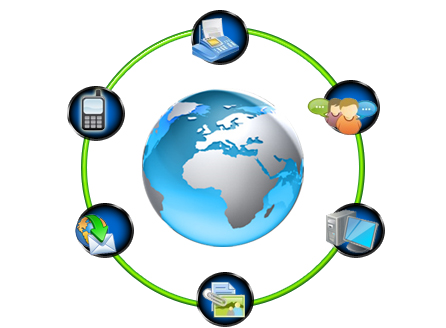
Today the world is considered as a global village, this has happened only due to the increase in communication technology.  The world is becoming smaller and smaller because of the use of highly advanced communication tools. 

An example of communication technology is teleconferencing. Teleconferencing is a telephone call between two or more people. The most simple form of teleconferencing is using three-way calling to setup your own teleconference between yourself and two other participants. More advanced PBX equipment can setup conference calls between more than three participants. Most businesses choose to use a teleconferencing service instead of purchasing and maintaining their own teleconferencing systems. Another advancement in the communication is the fax which is know as facsimile. It is a telecommunication technology used to transfer copies of documents, especially using affordable devices operating over the telephone network. The device is also known as a telecopier in certain industries. When sending documents to people at large distances, faxes have a distinct advantage over postal mail in that the delivery is nearly instantaneous, yet its disadvantages in quality have relegated it to a position beneath email as the prevailing form of electronic document transferal.


What Is Communication Technology ?


Technology plays an important  role in our society. Technology is  part our daily life and without it our living would not exist like now. Communication technology has contributed to globalization more than any other factor. The innovations in communication technology have promoted cooperation among nations and also have helped in greater interaction between people of different cultures. 

Globalization is dependent on communication technology, and communication technology is in turn dependent on globalization. Various reports over the years have concluded that communication technology will become one of the vital components in governance, and lead to a more transparent public administration system. Already, America and majority of countries in Europe have implemented a governing system that is based on the sharing of data and information and many developing countries like India, China and Brazil are following suit. Experts are of the view that putting a strategic communication technology system in place will help the developing countries to get better access to information from developed nations, and this could help them to compete in the world economy. Governments can now exchange data, research, analysis, and reports with each other on a real-time basis and this has led to increased cooperation between nations.


Examples Of Communication ?

Examples of Communication 


1. Human speech 

Speech is a natural form of communication for human beings, and computers with the ability to understand speech and speak with a human voice are expected to contribute to the development of more natural man-machine interfaces. Computers with this kind of ability are gradually becoming a reality, through the evolution of speech synthesis and speech recognition technologies. However, in order to give them functions that are even closer to those of human beings, we must learn more about the mechanisms by which speech is produced and perceived, and develop speech information processing technologies that make use of these functions. We use speech every day almost unconsciously, but an understanding of the mechanisms on which it is based will help to clarify how the brain processes information and will also lead to the development of more human-like speech devices through the imitation of these functions by computers. 


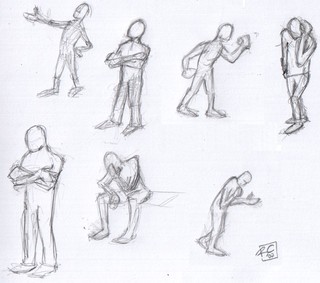
2. Body Language

Body Language - technically known as kinesics (pronounced 'kineesicks') - is a significant aspect of modern communications and relationships.
Body Language is therefore very relevant to management and leadership, and to all aspects of work and business where communications can be seen and physically observed among people.
Body language is also very relevant to relationships outside of work, for example in dating and mating, and in families and parenting.
Communication includes listening. In terms of observable body language, non-verbal (non-spoken) signals are being exchanged whether these signals are accompanied by spoken words or not.
Body language goes both ways:
  • Your own body language reveals your feelings and meanings to others.
  • Other people's body language reveals their feelings and meanings to you.
The sending and receiving of body language signals happens on conscious and unconscious levels.
                                                        
                                                                         3. Gesture
Gestures are a form of nonverbal communication in which visible bodily actions are used to communicate important messages, either in place of speech or together and in parallel with spoken words. Gestures include movement of the hands, face, or other parts of the body. Physical non-verbal communication such as purely expressive displays, proxemics, or displays of joint attention differ from gestures, which communicate specific messages.Gestures are culture-specific and can convey very different meanings in different social or cultural settings.Gesture is distinct from sign language. Although some gestures, such as the ubiquitous act of pointing, differ little from one place to another, most gestures do not have invariable or universal meanings but connote specific meanings in particular cultures. A single emblematic gesture can have very different significance in different cultural contexts, ranging from complimentary to highly offensive.
   
                                                                           4. Sign
A sign is understood as a discrete unit of meaning in semiotics. It is defined as "something that stands for something, to someone in some capacity" It includes words, images, gestures, scents, tastes, textures, sounds – essentially all of the ways in which information can be communicated as a message by any sentient, reasoning mind to another. The nature of signs has long been discussed in philosophy. Initially, within linguistics and later semiotics, there were two general schools of thought: those who proposed that signs are ‘dyadic’ (i.e. having two parts), and those who proposed that signs are interpreted in a recursive pattern of triadic (i.e. three-part) relationships.


What is Communication?

Think of all the ways you communicate everyday.

You think, you read, you speak, you make lists, you gesture, you listen to the radio, you chat on facebook, you watch TV, you talk on your cell-phone...

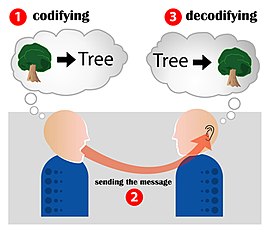
Communication is two-way process of reaching mutual understanding, in which participants not only exchange (encode-decode) information but also create and share meaning.


Communication is the sharing of ideas and information. While many people think of communication primarily in oral or written form, communication is much more. A knowing look or a gentle touch can also communicate a message loud and clear, as can a hard push or an angry slap. 

Over time, the methods and means used to communicate have expanded greatly. In early records, hieroglyphics and primitive cave paintings were used to communicate information and transmit messages. Oral stories and traditions were also passed down through generations and eventually many of these stories also came to be written down in some cultures.

The use of carrier pigeons, followed by Morse code and telegraph technology expanded the reach of communication, making it possible for people to send messages over longer distances.


Today, communication has expanded and is easier than ever before. Television allows messages to be communicated quickly and instantly to millions of viewers worldwide, and viewers can watch events such as political elections unfold in real time.

Perhaps nothing has changed communication so much as the Internet. While television and radio provided one-way communication, the Internet allows for the two-way exchange of information and lets people throughout the world send data instantly and share ideas immediately. Video chat, instant messages and even voice-over-IP telephone systems make it possible to connect with and communicate with more people than ever before.